ServicesVehicle Restraints
Vehicle Restraints in Kingston, PA
A vehicle restraint locks the trailer to your building until the dock crew decides it can leave. We repair, replace and install hook-style, wheel-based and manual restraints, and we match the design to the trailer mix your facility really receives, not a catalog default.
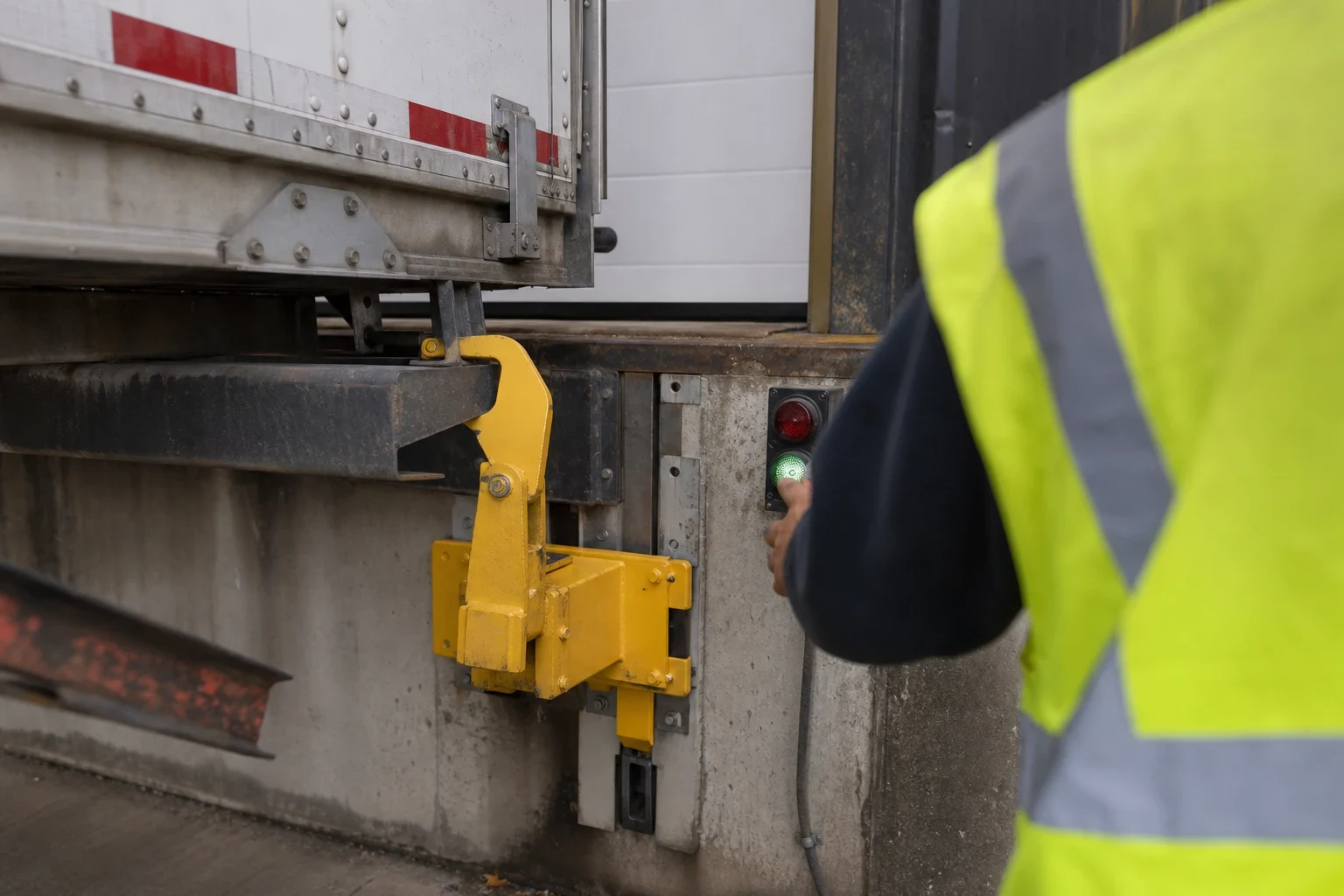
How a Restraint Works and Choosing the Right Type
Each time a forklift drives onto a trailer, it nudges the trailer a little farther from the dock. Across a whole unload, that creep can leave a gap between the leveler lip and the trailer bed, and if the driver leaves too soon, the gap becomes a drop. A restraint prevents both by holding the trailer against the building until your dock crew lets it go.
Most docks use a rotating steel hook that swings up and catches the trailer's rear impact guard, known as the ICC bar. It takes little space, mounts to the dock face and works with most standard van trailers. The weak point is that bar: a guard that is bent, missing or in an odd spot, a hydraulic liftgate or a low-deck trailer can give the hook nothing firm to grab. Wheel-based restraints hold the rear tires instead, so they secure nearly any trailer, but they need a sound concrete pad and more room on the approach. Manual chock-style restraints are cheaper and fit low-traffic doors, but only work if someone sets them every single time.
The drive matters as well. Hydraulic units are powerful and move smoothly, but their fluid thickens in the cold and every hose is a possible leak. Electromechanical units run on a gearmotor and have fewer parts that need sealing. We go over these trade-offs with you before making a recommendation.
What Our Restraint Work Covers
Hook restraint repair
We replace worn hooks, carriage rollers, springs, limit switches and drive motors. We also check that the carriage rides freely in its track, since a binding carriage is a common reason a hook fails to rise to the bar.
Wheel-based restraint service
We inspect the locking arm, the ground track and its anchors, and the sensors that confirm the tire is captured. Loose anchors in cracked concrete are addressed before they let the unit shift under load.
Light and signal systems
Red and green lights inside and outside tell the driver and the forklift operator who has control of the trailer. We repair failed lamps, wiring and control boxes so the signals match the restraint's real position.
Interlocks with dock equipment
A restraint can be wired so the dock leveler will not operate, or the overhead door will not open, until the trailer is locked. We set up and test these interlocks on new and existing doors.
Replacement and new installs
When a unit is beyond repair or a door never had one, we install a new restraint matched to your trailer mix, mounting surface and controls.
When a Restraint Is Overdue for Service
- Hook rises but finds nothing
- A fault on the control panel after the hook travels up, or a crew that overrides the unit just to keep loading, means the trailer is sitting unlocked. Tired springs, a bent hook or a damaged ICC bar on the trailer are the usual culprits.
- Lights that disagree
- Green outside while the restraint is still engaged, or red that never clears, means a failed sensor or wiring fault. Drivers stop trusting the signals quickly.
- Slow or noisy travel
- Grinding, chattering or a carriage that moves in jerks points to dirty tracks, dry rollers or a tired motor. Road salt and slush packed into the track over winter make this worse.
- Fluid under a hydraulic unit
- Oil on the drive or dock face means a hose, fitting or cylinder seal is leaking. Low fluid weakens holding force before the unit stops working altogether.
- Trailers moving during loading
- If you feel the trailer shift or see the leveler lip creeping toward the edge, the restraint is not holding, or the trailer type is one your current design cannot catch.
How a Restraint Job Runs
- 1
Inspect and test
We cycle the restraint against a trailer or test fixture, check the hook or arm, drive, sensors and lights, and look at the mounting and the concrete around it.
- 2
Explain repair or replace
You get a plain answer on whether the unit is worth repairing, which parts have failed and why. If a different restraint type would hold your trailers better, we explain the material and drive trade-offs.
- 3
Schedule around your shipping
We plan the work for the door and time that cause the least downtime, so other doors keep receiving while one is out of service.
- 4
Repair, install and verify
After the work, we test engagement, release, lights and any interlocks with the dock leveler or overhead door, then show your crew how the controls behave.
What Moves the Cost of Restraint Work
A repair that needs a spring and a limit switch is a very different job from replacing a hydraulic unit or adding a wheel-based restraint to a door that never had one. We give you a written estimate after seeing the equipment, with parts and labor listed separately.
- Restraint type and drive
- Hook, wheel-based and manual restraints differ in hardware and install time. Hydraulic and electromechanical drives also differ in parts and service needs.
- Mounting surface
- A solid dock face or pad keeps installs simple. Spalled concrete, a damaged bumper wall or a steep approach can require repair before a restraint can be anchored.
- Controls and interlocks
- Running power, adding light packages, or tying the restraint into leveler and door controls adds wiring and testing time.
- Parts availability
- Common components are easy to source. Older or discontinued units may need adapted parts, which sometimes makes replacement the better value.
Vehicle Restraint Questions
- Should we choose a hook restraint or a wheel-based restraint?
- If nearly all your trailers are standard vans with intact rear impact guards, a hook restraint is compact and dependable. If you see liftgate trucks, low-deck trailers or damaged guards, a wheel-based restraint holds what a hook cannot. We look at your actual trailer traffic before recommending one.
- Can a restraint be added to an existing loading dock?
- Usually yes. Most hook restraints mount to the dock face, and wheel-based units anchor into the pad in front of the door. We check the concrete, bumpers and power supply first so the new unit has something solid to hold against.
- Are wheel chocks enough?
- Chocks can work at low-traffic doors when they are set every time. The trouble is they rely on the driver or crew, and on icy or wet pavement a chock can slide. A powered restraint with lights gives a visible, consistent lock.
- Do you work on restraints from different manufacturers?
- Yes. Most restraints share the same basic parts: a hook or arm, a carriage or track, a drive, sensors and a control box. We diagnose the unit you have and tell you if parts for an older model are hard to find.
- What happens to that dock door while you work on it?
- It stays closed to trucks while the restraint is apart, so plan on rerouting deliveries for that door. A single visit handles most repairs. Swapping out a whole unit or adding a wheel-based restraint takes longer, more so when the pad needs concrete repair or new power has to be run. You get our downtime estimate before work starts, so receiving can plan around it.
Get a Restraint That Holds Your Trailers
Tell us what your restraint is doing and what trailers you receive. We will explain the repair or the right replacement type, and you can ask about dock levelers or overhead doors on the same call.