ServicesPreventative Maintenance
Loading Dock Preventative Maintenance in Kingston
We service your dock levelers, overhead doors, vehicle restraints, seals and bumpers on a set schedule. Each visit catches worn hinges, leaking cylinders and tired springs while they are still cheap to fix, so your receiving schedule keeps running.
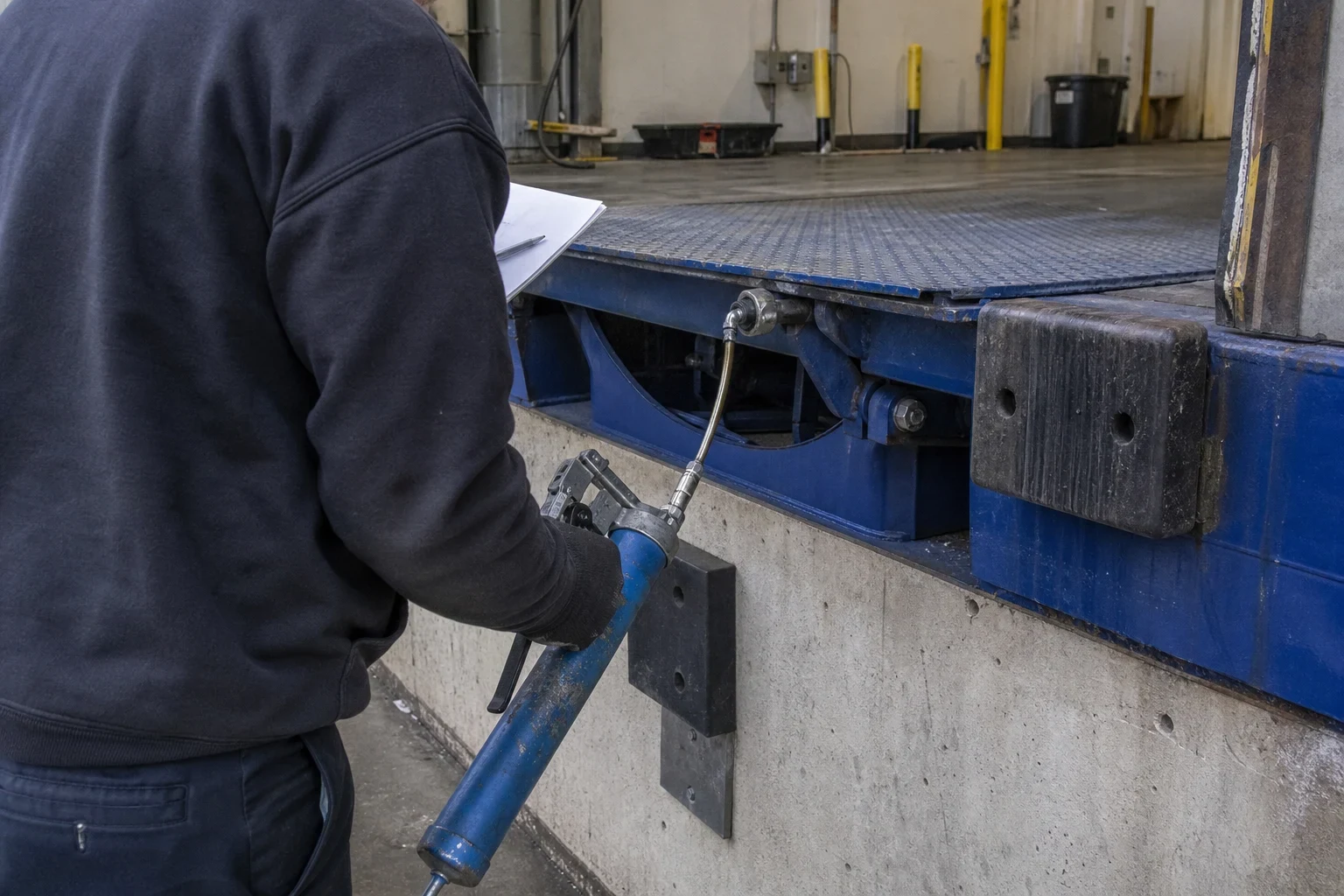
What preventative maintenance covers and when it pays off
Dock equipment wears in predictable ways. Hydraulic seals harden, lip hinge pins gall from steel-on-steel contact, torsion springs lose tension cycle by cycle, and rubber bumpers split under repeated trailer impact. Preventative maintenance means inspecting and servicing those parts on a calendar instead of waiting for a leveler to stall with a trailer at the door.
It is the right call for any facility running more than a few trailers a day, and for any site where one dead dock position backs up shipping. Warehouses, distribution centers, grocery receiving and manufacturing plants all benefit, because the cost of a missed load usually outweighs the cost of the visit.
Because different materials fail differently, we tell you what each part is made of and how it is aging. A laminated rubber bumper and a molded one wear at different rates, and that changes how often you replace them.
What we check on every dock position
- Dock leveler inspection and lubrication
- We grease the lip hinge and rear hinge, check hydraulic fluid level and condition, and look for weeping at cylinder seals and hose fittings. On mechanical levelers we check the hold-down and main spring tension. Cracked welds on the deck plate or header get photographed and noted.
- Overhead door service
- We inspect torsion springs, cables, drums and rollers, then balance the door and lubricate bearings. Bent track sections and worn nylon or steel rollers are flagged, since a binding door strains the operator and the panels.
- Vehicle restraint function test
- We run each restraint through a full engage-and-release cycle at your typical trailer bumper height and watch how the hook or bar seats. We also verify that the driver-side and dock-side signal lights change in step with the restraint. Slow engagement, or a green light that shows before the hook is locked, is a safety issue and gets handled that way.
- Seals, shelters and bumpers
- Foam-core dock seals compress and tear over time, and vinyl covers crack in cold weather. We measure bumper wear against the original projection, because a bumper worn too thin lets trailers strike the wall and the leveler lip.
- Written report with photos
- You get a position-by-position list of what we found, what we fixed during the visit and what needs attention next. Items are ranked by safety and by how soon they are likely to fail.
Signs your docks are overdue for service
The leveler drifts or rises slowly
A hydraulic leveler that sinks under a parked load or takes longer to raise often has low fluid, a failing seal or air in the system. Left alone, it can drop when a forklift crosses it.
The lip does not fully extend
When the lip hangs short of the trailer bed, it is usually a dry or galled hinge or a weak lip cylinder. It leaves a gap that catches pallet jack wheels.
Doors jerk, bang or reverse
Uneven travel points to a spring losing tension, a frayed cable or worn rollers. Ignoring it shortens the life of the operator and the panels.
Daylight around closed seals
Gaps at the head or side pads mean the foam has taken a set. In a Kingston winter that gap lets in cold air and road salt slush, raising heating costs and slicking the dock floor.
Bumpers worn to the bolts
Once mounting hardware shows, impact load goes straight into the concrete and the leveler frame.
How a maintenance visit runs
- 1
Plan around your schedule
On the phone we go over how many doors you have, what equipment is on each and when your docks are quietest. We work positions one at a time so the rest stay open.
- 2
Lock out and inspect
Power to the position is locked out, and the leveler deck is raised and propped on its own maintenance strut before any of us reaches under it. Overhead doors come fully down so spring tension can be checked with nothing moving. With the position secured, we go through its checklist part by part.
- 3
Adjust and service on the spot
Lubrication, spring and limit adjustments, fluid top-offs and minor hardware replacement happen during the visit. Larger repairs are quoted separately so you decide when to do them.
- 4
Report and next interval
Before we leave we walk you through the findings and recommend a service interval based on your traffic, whether that is quarterly, twice a year or annually.
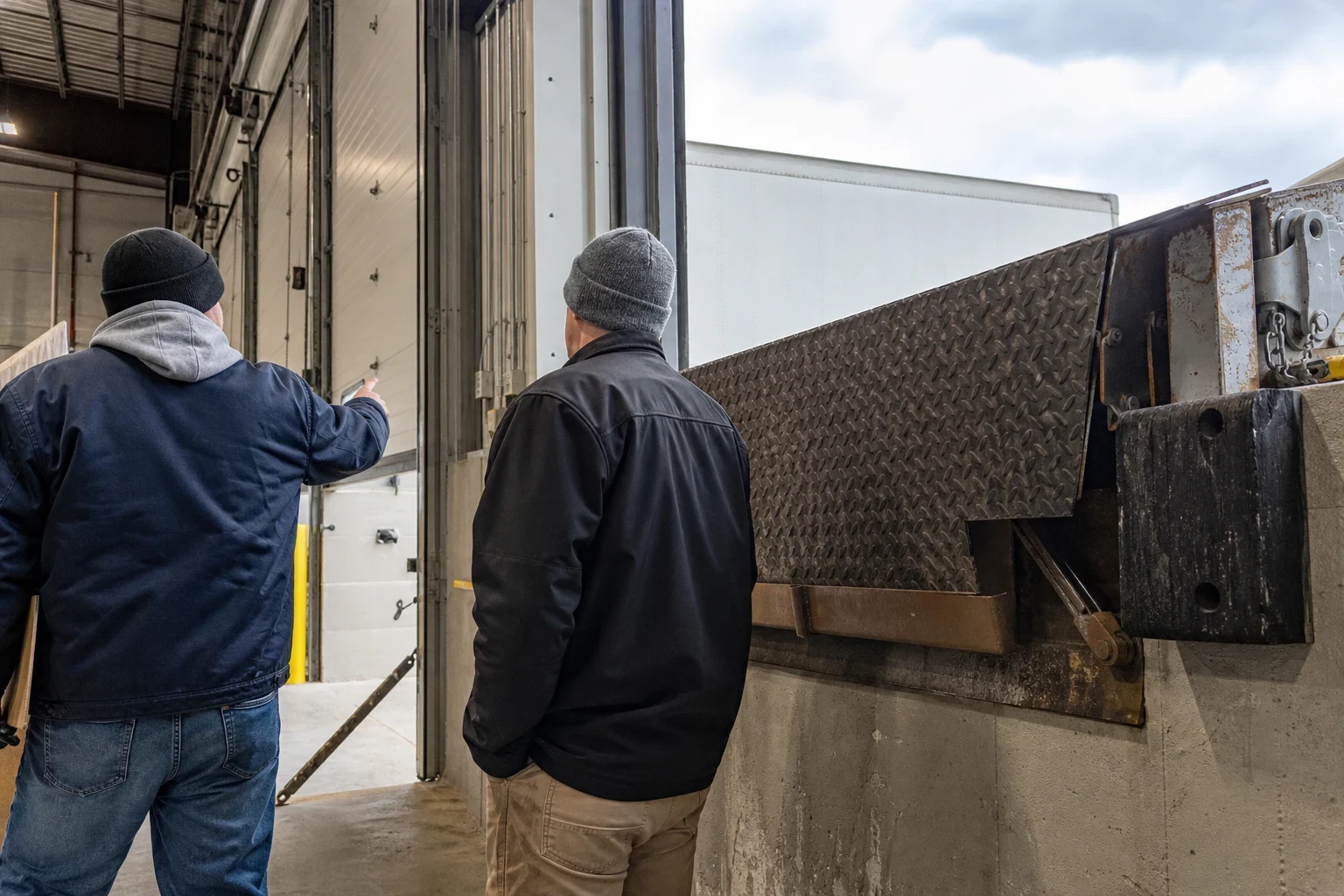
What moves the cost of a maintenance program
Pricing depends mostly on how many positions we service and what is installed at each one. A hydraulic leveler with a restraint and a high-speed door takes longer than a mechanical leveler with a manual door. We give you the scope and the number by phone once we know your equipment.
- Number and type of positions
- Each dock position adds labor, and hydraulic, air-powered and mechanical levelers each have different service steps.
- Visit frequency
- High-traffic sites running multiple shifts usually need more frequent visits than a store taking a few deliveries a week.
- Condition of the equipment
- Older equipment with dry hinges, contaminated fluid or rusted pit frames takes more time to bring back to spec.
- Parts replaced during the visit
- Fluid, rollers, cables, bumpers and seal pads are billed as used, and we tell you before replacing anything beyond routine items.
Common questions about dock maintenance
Something not covered here? (570) 608-8454
How often should our dock equipment be serviced?
Most of the sites we work at do well with two visits a year. Plants with nonstop forklift traffic and distribution centers on two or three shifts usually move to quarterly. A store getting only a few trucks each week may need just one annual visit. We base the schedule on your cycle counts and what we see on our first visit.
Do all our docks have to close at the same time?
No. We work on a single position, put it back in service, and only then move to the next. If your receiving window is tight, let us know and we will plan around it.
Will you service equipment that a different company installed?
Yes. A lot of the equipment we look after was put in by others, and we work on levelers, doors, restraints and seals from the common brands. If a part has been discontinued, our report notes it and lists the replacement options.
What if you find a problem that needs a larger repair?
We take photos, explain what caused it and price the repair separately. When it is a safety hazard, like a restraint that will not engage or a cracked lip hinge, we advise tagging the position out until it is fixed.
Does regular maintenance help with insurance inspections and safety audits?
Each written report is a dated record of what we inspected and serviced at every position. Many facilities file them as proof that their equipment is maintained, which supports compliance and safety reviews.
Keep every dock position earning its keep
Tell us how many doors you run and what sits at each one, from leveler type to restraint and door, and we will recommend an interval that fits your traffic. We serve facilities in Kingston, Wilkes-Barre, Plains and the surrounding towns.