How We Work on Loading Docks in Kingston
We repair, maintain and install dock levelers, vehicle restraints and commercial doors for facilities that depend on a working dock. Before we recommend a part, we explain what it is made of, why the old one failed and what each option costs you in upkeep.
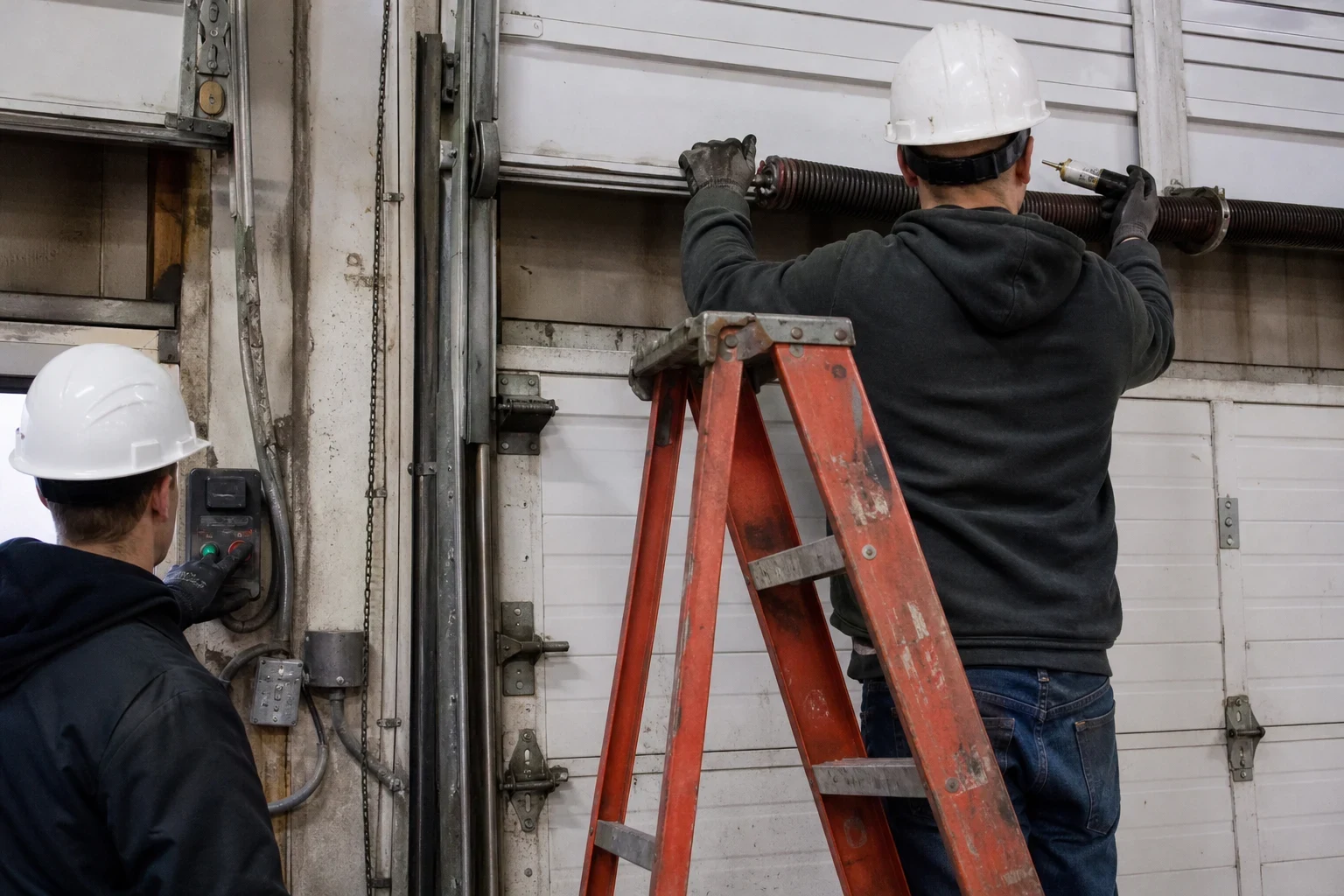
Why we start with what a part is made of
Our customers run receiving docks: storage and distribution warehouses, plants shipping finished goods, supermarkets and big-box stores taking daily deliveries, and freight carriers cycling trailers through their doors. We handle dock levelers, vehicle restraints, overhead doors, high speed doors and rolling grilles, along with the preventative maintenance that keeps that equipment running between repairs.
Most dock failures trace back to a material reaching its limit. A hydraulic leveler hose cracks after years of flexing in cold air. Lip hinge pins wear flat when nobody greases them. A fabric panel on a high speed door tears where it rubs a bent guide. We look for that cause first, because swapping a part without fixing what wore it out only schedules the next breakdown.
So we talk in terms of materials. Galvanized or painted steel track, polyurethane or vinyl curtain, mechanical or hydraulic leveler, aluminum or steel grille slats: each choice carries trade-offs in price, service life and maintenance. We lay them out so you can match the equipment to your truck traffic and budget. We are OSHA 30 certified, and that training shapes how we lock out equipment and work beside a live dock.
What you can expect on a job
Diagnosis before parts
We inspect the whole assembly, not just the part that broke. If a leveler deck sags, we check the hinge, the hold-down and the cylinder before calling it worn out. You get an honest repair-or-replace answer and photos of what we found.
Options listed by spec
Our written estimates list each line item with the material, gauge or rating it uses. When two options exist, such as a steel slat rolling grille versus an aluminum one, we note how each handles impact, corrosion and weight so the difference is clear before you decide.
Work planned around your downtime
We schedule with your receiving hours in mind and take one door or position out of service at a time when the job allows. Equipment is locked out while we work, and every leveler, restraint and door is cycled and tested before we hand it back.
A year of coverage on our labor
Every repair and installation we complete is covered by a 1-year labor warranty. Should our workmanship be the reason a part stops working within those twelve months, we return and correct it.
Docks we reach
Our crews travel to facilities in Kingston, Wilkes-Barre, Edwardsville, Forty Fort, Luzerne, Hanover, Plains, Plymouth, Exeter, Swoyersville and Jackson. Winter road salt carried in on trailer tires speeds corrosion on dock pits and door bottoms, so we factor coatings and drainage into the options we suggest for your dock.
- Kingston
- Wilkes-Barre
- Edwardsville
- Forty Fort
- Luzerne
- Hanover
- Plains
- Plymouth
- Exeter
- Swoyersville
- Jackson
Tell us what your dock is doing
Describe the symptom, the equipment and how your dock is used, and we will talk through likely causes and the options that fit. Get your quote by phone and set a time that works around your receiving schedule.