ServicesEquipment Sales
Loading Dock Equipment Sales in Kingston
We sell dock levelers, overhead doors, high speed doors, rolling grilles and vehicle restraints, and we spec each one from your dock's measurements, your forklift weights and your trailer mix. You hear the material trade-offs in plain terms before you buy anything.
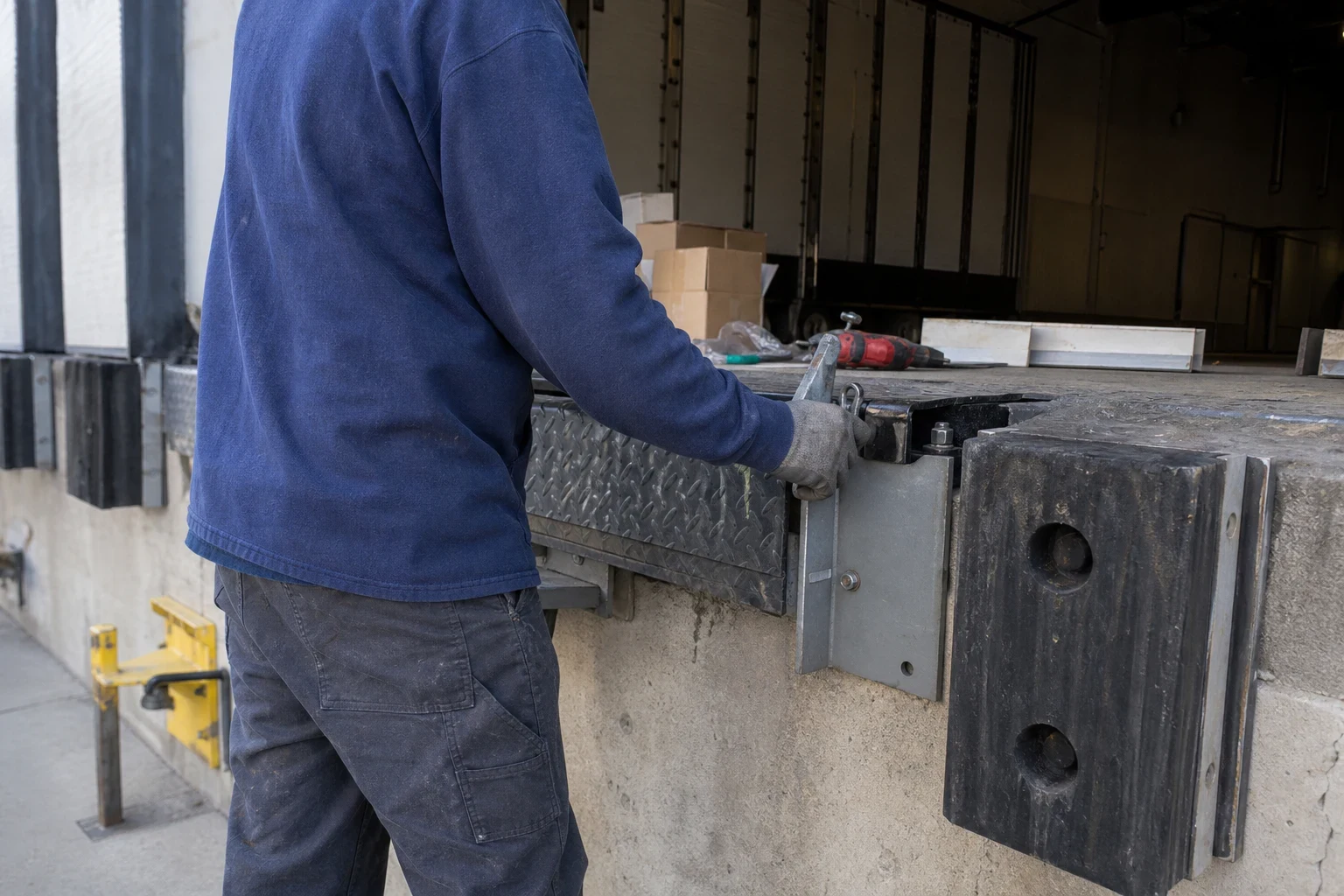
Buying dock equipment that fits the work
Most dock equipment problems start at the purchase. A leveler rated too low for today's forklifts cracks at the hinge. A door with thin skins dents from pallet strikes. A restraint that can't reach a damaged rear impact guard sits unused. We sell equipment the way we would want to buy it: measured first, matched to the load, with the reasons written down.
Material choice drives most of that decision. Steel gauge, insulation type, deck plate thickness and seal compounds all behave differently under heavy traffic and Northeastern Pennsylvania freeze-thaw cycles. We explain those differences so you can weigh service life against budget yourself.
When you're ready, the same crew handles loading dock equipment installation, so the spec and the fit-up stay in one set of hands.
What we sell and how we compare it
Dock levelers
Pit-style levelers that run on hydraulics, springs or an air bag, along with compact edge-of-dock plates for docks that see only occasional trucks. Hydraulic units cost more up front but have fewer springs and chains to wear. We size capacity to your heaviest loaded forklift, not the average one.
Vehicle restraints
Hook-style units latch onto the steel bar hanging below the trailer bumper. When carriers keep arriving with that bar bent, missing or mounted too low, a restraint that locks against the tire is the better choice. We look at your carrier mix before recommending either.
Overhead doors
Sectional steel doors in different skin gauges, with polystyrene or polyurethane insulation, and rolling steel doors where headroom is tight. Polyurethane bonds to the skins and resists denting better, and it holds more heat per inch.
High speed doors
Fabric doors with PVC curtains that open and close fast to hold temperature between zones. Many use a breakaway curtain that resets after a forklift strike instead of bending a panel.
Rolling grilles
Aluminum, galvanized steel and stainless grilles for security with airflow. Aluminum is lighter and won't rust; steel takes impact better at a busy opening.
Bumpers and controls
Molded or laminated rubber bumpers, steel-faced bumpers for high-impact positions, and interlocked control panels that tie the door, leveler and restraint together.
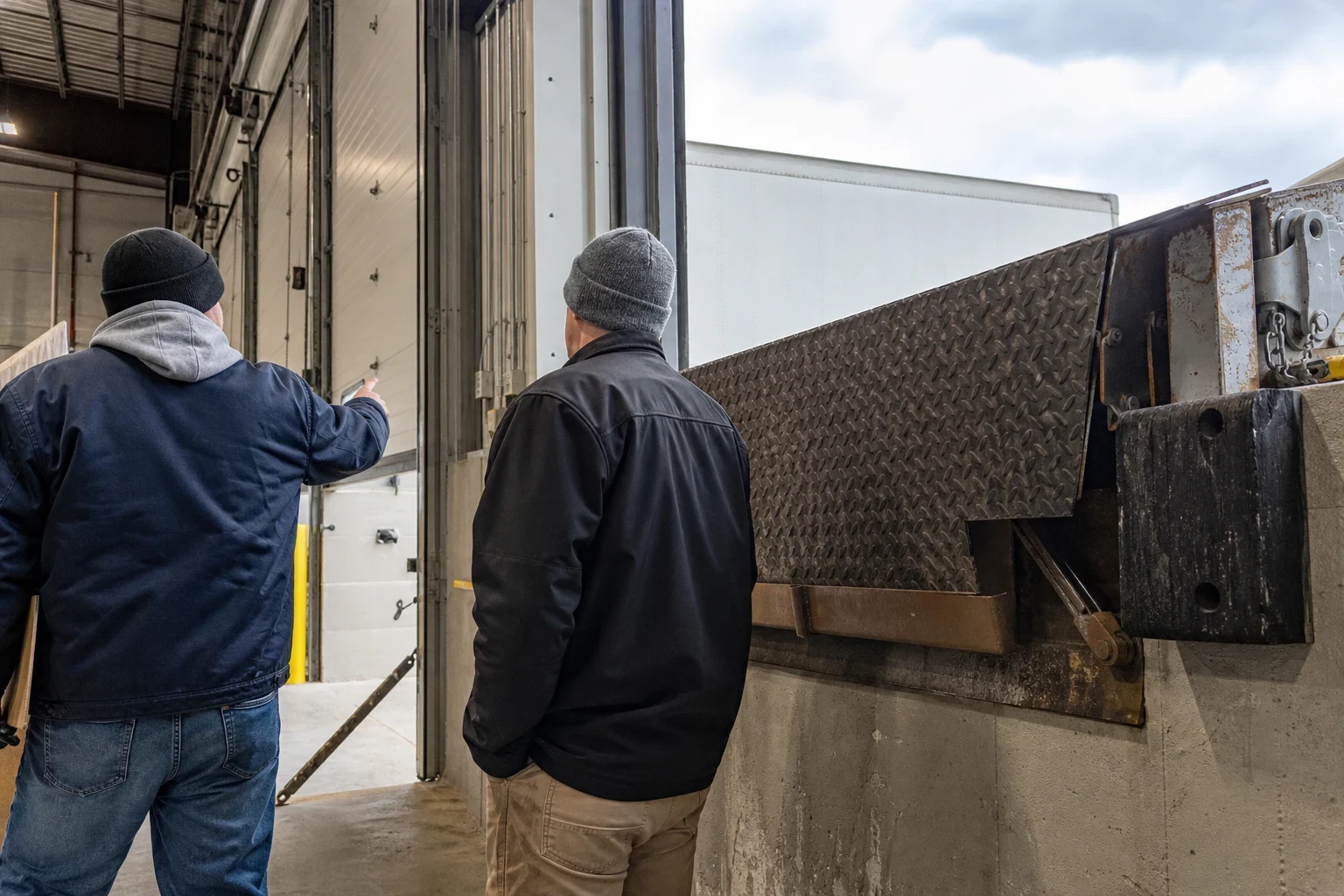
Signs it's time to buy instead of repair
- The same part keeps failing
- When a leveler needs its lip hinge rewelded or hold-down springs replaced every season, the frame is usually fatigued. More repairs only chase the next crack.
- Your forklifts got heavier
- Electric lift trucks carry heavy batteries. A leveler bought for lighter propane trucks can be overloaded on every crossing without anyone noticing until the deck sags.
- Trailers the restraint can't catch
- If drivers keep backing in with bent or missing rear impact guards, a hook restraint can't lock them. A wheel-based restraint closes that safety gap.
- Doors that leak heat or won't stay square
- Dented, uninsulated panels let cold air pour into a heated warehouse all winter. Once sections are bent past straightening, a new insulated door is the cleaner fix.
- You're adding dock positions
- New doors on a building expansion are the right moment to standardize models, so parts and service match across the dock.
How a purchase works with us
- 1
A phone conversation first
You tell us what's failing or what you're adding, plus rough traffic and freight type. We ask about forklift weights and trailer types so the site visit is focused.
- 2
Measuring the dock
We measure dock height, pit dimensions, door openings and headroom, and we check the condition of the pit curb angle and concrete. Those numbers decide which models will physically fit.
- 3
A written, line-item proposal
You get each piece of equipment listed with its capacity, construction and options, plus a note on why we chose it. Where two options would both work, we show both and explain the trade-off.
- 4
Ordering and fit-up
Once you approve, we order and schedule delivery. Installation can be planned around your shipping hours to keep downtime low.
Why equipment quotes differ
A pair of levelers with the same deck size can be priced far apart, and most of the gap sits in steel and hydraulics you never see once they're installed. Our proposals give every piece of equipment its own line, so you can judge which upgrades pay off at your facility and which ones you can leave out.
- Capacity and size
- Higher capacity ratings mean thicker deck plate and heavier structural members. Longer decks and wider doors add steel too.
- Operating type
- Hydraulic levelers and powered restraints cost more than mechanical units but usually need less adjustment over time.
- Materials and insulation
- Skin gauge, polyurethane versus polystyrene, aluminum versus steel grille slats, and stainless hardware all change the number.
- Existing conditions
- A damaged pit, spalled concrete or a door opening out of square needs work before new equipment can go in.
- Controls and interlocks
- Tying the door, leveler and restraint to one control panel adds wiring and components, and it adds a real safety layer.
Questions about buying dock equipment
- Will a new leveler fit my existing pit?
- Often, yes. Pit levelers come in standard widths and lengths, and we measure yours before recommending a model. If the pit is an odd size or the curb angle is damaged, we'll tell you what has to be corrected first.
- Should I choose hydraulic or mechanical?
- Mechanical levelers cost less and work well at docks with moderate traffic and attentive operators. Hydraulic units suit busy docks because they operate with a push button and have fewer springs to adjust. We'll look at how many trucks you turn per shift before suggesting one.
- Is an insulated overhead door worth it?
- For a heated or cooled space, usually. Polyurethane-insulated sections hold temperature better and stiffen the panel against dents. For an unheated storage bay, a non-insulated steel door may be all you need.
- Do you install what you sell?
- Yes. Our loading dock equipment installation crew handles the fit-up, and afterward our loading dock preventative maintenance visits can keep it adjusted.
- Can new equipment work with what I already have?
- In many cases. A new vehicle restraint can be interlocked with an existing door and leveler if the controls are compatible. We check that during the site visit rather than assuming.
Get the right equipment on your dock
Tell us what you're replacing or adding, and we'll set up a time to measure and talk through the material options. You'll get a written proposal you can compare line by line.